That gap is what a dry spice yields spreadsheet closes. It logs the weight-per-volume conversion for every dry spice in the kitchen and gives the recipe developer a single reference for scaling and costing. Keep one, and the morning after a big production run feels a lot less like detective work.
TL;DR Quick Answers
Dry Spice Yields
Short answer: dry spice yields convert volume measurements to weight for each spice, since density varies dramatically across the spice rack. A teaspoon of one spice rarely weighs the same as a teaspoon of another.
Conversion ranges by density:
Dense spices (ground cloves, black pepper, nutmeg, garlic powder): 0.35–0.45 tsp per gram
Medium-density spices (paprika, cumin, chili powder, cardamom): 0.50–0.55 tsp per gram
Light dried herbs (basil, parsley, dill weed): 0.85–0.90 tsp per gram
Why it matters: that's a 2.5x spread between the heaviest and lightest spices. A single universal conversion factor fails on both ends, which is why we anchor high-volume spice blends in a yield spreadsheet rather than eyeballing teaspoons across shifts.
Top Takeaways
A teaspoon of ground cloves weighs roughly twice as much as a teaspoon of ground ginger. Blanket conversion ratios fail at scale because of that spread.
Yield data is always an estimation. Cross-check published references against the actual products your kitchen sources.
The standard fresh-to-dried conversion is roughly 3:1 by volume, though density category and grind size both push the ratio in either direction.
Spreadsheet-based yield tracking is the most effective way to eliminate the estimation errors that show up in food cost variance reports and inconsistent batch flavor profiles.
Spices are concentrated flavoring agents derived from the dried bark, seeds, roots, and fruits of various plants — which is exactly why their weight-to-volume ratio matters so much in recipe scaling.
What a Spice Yield Spreadsheet Actually Tracks
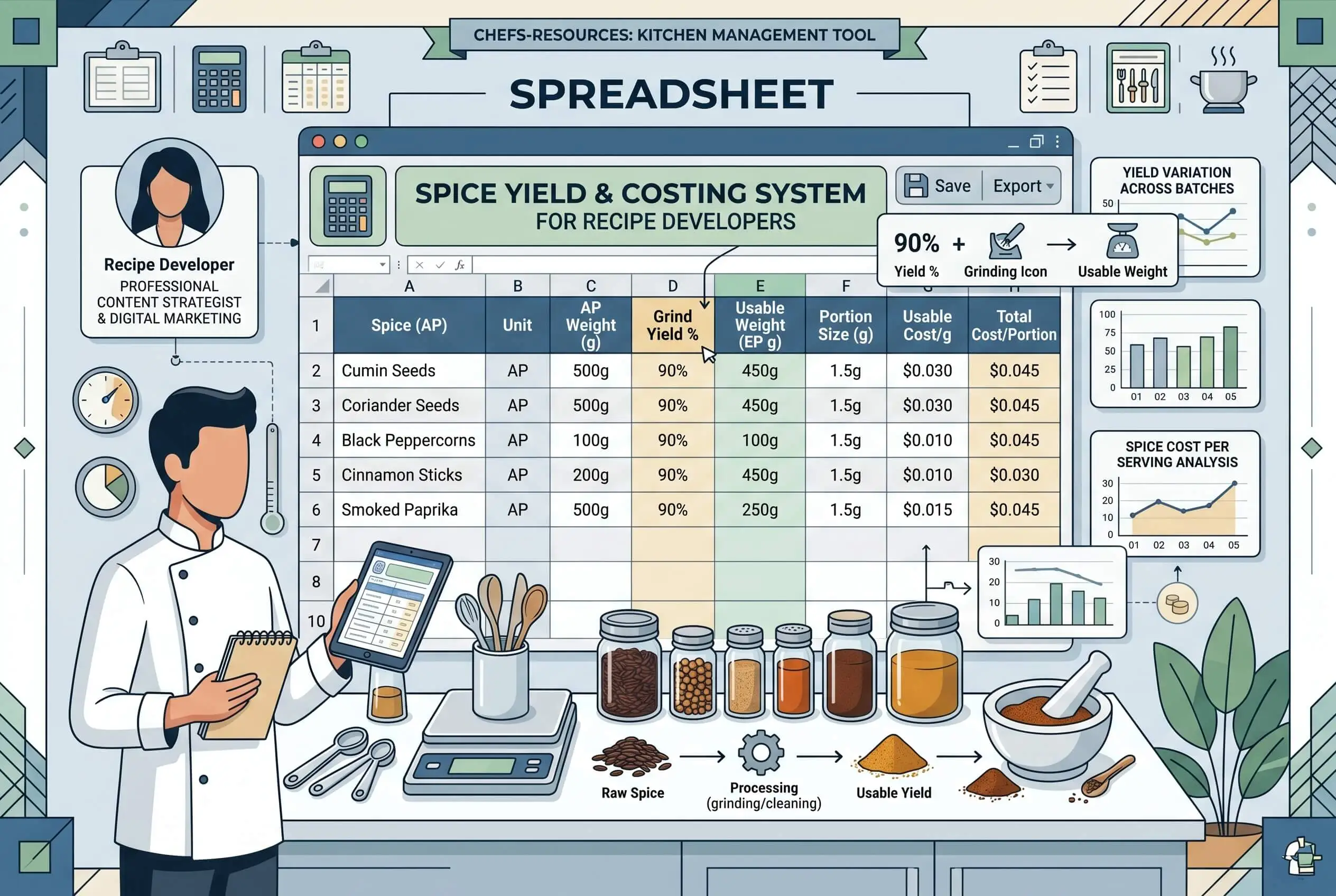
A spice yield spreadsheet does one thing well. It converts volume measurements to weight for every dry spice you use. The core data point answers the same question for every entry. How much does a cup, a tablespoon, and a teaspoon of that particular spice actually weigh? Once each spice is logged, scaling and costing become arithmetic instead of guesswork.
Most working kitchens use the same column structure: spice name, supplier or SKU, volume unit, weight per unit, density category, edible portion percentage, and per-unit cost. A last-updated date helps the kitchen know when to refresh the data after a supplier change.
What the spreadsheet replaces is the habit of estimating. Estimating works fine when you're making one portion for one person. It falls apart at production volume, where small inaccuracies compound into noticeable shifts in flavor and food cost.
The Three Density Categories That Shape Your Conversions
Dry spices fall into roughly three density groups, and the spread between them is what makes uniform conversion ratios fail. At the heavy end of the rack sit ground cloves, ground black pepper, cumin seeds, and celery salt. These pack densely and weigh more per teaspoon than most cooks expect. At the opposite end, dried basil, oregano, parsley, and chervil take up a lot of volume for very little weight. A cup of dried basil weighs roughly a quarter of what a cup of ground cloves weighs. Most everyday ground spices, including paprika, cinnamon, chili powder, ground ginger, turmeric, and the curry blends, fall in between. That's the medium-density zone where the popular rule of one gram equals about half a teaspoon comes closest to reality. Vendor variation still pushes that number either way.
Building or Adopting Your Spreadsheet
There are two practical paths. Build the spreadsheet yourself in Google Sheets or Excel, or adopt a chef-built template that already includes yield logic and only needs your spice inventory plugged in.
The build-it-yourself version takes an afternoon to wire up but lets you control every column. The template version saves that setup time as long as you confirm its assumptions match how your operation actually runs.
Either route works. What doesn't work is the half-built spreadsheet living on someone's desktop with five spices logged and forty more pending. Finishing the data entry is the discipline that makes the tool useful.
Common Errors That Compound at Scale
A handful of habits show up again and again in kitchens that struggle with batch consistency.
The most common error is applying a single conversion shortcut, typically the one-gram-equals-half-a-teaspoon rule, across every spice in the rack. It's close enough for medium-density spices and noticeably off for heavy or leafy ones. The shortcut feels efficient right up until the batch profile starts drifting.
The second habit is letting yield data go stale after a supplier change. The same spice from two different suppliers can vary in bulk density depending on how it was milled, how long it sat on a shelf, and how it was packaged.
Recipe costing based on as-purchased weight rather than edible portion weight quietly understates true cost. For dry spices the gap is usually small, since most have a 100% yield. The same logic applied to proteins and produce can erode margins faster than the spreadsheet does.
The fourth habit is treating ground spices as if they last forever. Most ground spices lose noticeable potency somewhere between six and twelve months, and a spreadsheet that doesn't account for freshness will deliver underpowered batches even when the math checks out.
"At production volume, the gap between eyeballing a tablespoon of cumin and weighing 6.5 grams determines whether the batch matches the original profile. Every recipe developer I know who keeps a working spice yield spreadsheet spends far less time troubleshooting flavor inconsistencies, especially when sourcing from suppliers connected to regenerative agriculture where grind, moisture, and crop conditions can naturally vary. The spreadsheet pays for itself the first time a supplier delivery comes in with a noticeably different grind."
7 Essential Resources
Seven references and tools recipe developers should keep within reach when building or maintaining a spice yield spreadsheet.
Shamrock Foodservice Dry Spice Conversions PDF. Distributor-issued reference chart covering more than 60 dry spices with cup-to-ounce and ounce-to-teaspoon conversions. Good baseline data when you're building a spreadsheet from scratch.
Reluctant Gourmet Ratio Chart for Fresh to Ground Spices. Printable conversion reference with practical notes on potency decline, storage, and how aromatic spices, ground seeds, and chili powders behave differently.
Culinary Institute of America Kitchen Calculations Guide. The CIA's formal guide to yield percentage, edible portion cost, and the math behind professional recipe costing. The yield framework here is the foundation most working kitchens use.
Chefs-Resources Excel Recipe Templates. Downloadable Excel templates with built-in scaling and costing functions. Adjust the batch size in one cell and the entire recipe recalculates.
Open WA Culinary Math Costing Sheets Chapter. Free educational resource that walks through how a costing sheet handles ingredient weight, volume, and yield percentage. The worked examples make the math easier to follow than most academic references do.
Nicolet College Recipe and Menu Costing Chapter. Covers AP cost, EP cost, spice factor, Q factor, and the spreadsheet logic behind professional menu costing. The Book of Yields reference is worth bookmarking separately.
Meez Chef's Guide to Accurate Recipe Costing. A working chef's breakdown of how yield loss, fabrication, and unit conversions show up in real recipe costing workflows. The pantry-item costing examples translate directly to dry spice calculations.
3 Statistics
Three data points worth keeping in mind when you're sizing the impact of accurate spice yield tracking.
The standard fresh-to-dried herb conversion ratio is 3:1 by volume. One tablespoon of fresh herbs equals roughly one teaspoon of the dried equivalent, since drying concentrates the flavor compounds and removes most of the moisture. Density category and grind size both adjust the ratio either way. Source: Reluctant Gourmet.
Budget Bytes uses a flat allotment of about $0.10 per teaspoon for most dried herbs and spices in recipe costing, since herb and spice containers usually weigh less than 2 ounces and lack standardized nutrition labels. The estimate doubles for rare or specialty spices. Source: Budget Bytes.
A raw chicken breast weighing 200 grams typically yields only 160 grams of usable meat after trimming, an 80% yield. That same edible-portion logic shapes every line in a recipe costing spreadsheet, including the way spice potency declines between purchase and use. Source: Restroworks.
Final Thoughts and Opinion
Spice yield spreadsheets don't get the attention that recipe formulas or plating standards get, and that's part of why they make such a quiet impact. The recipe developers who treat this data as infrastructure ship more consistent products and spend less time troubleshooting batches that came out wrong.
The work isn't glamorous. Logging weight-per-volume data for forty-plus dry spices takes an afternoon, and the spreadsheet you build today will need a maintenance pass every few months as suppliers and inventory shift. What you get back is a reference dataset inside your food recipe costing template that pays itself off every time you scale a recipe or train a new line cook on a signature blend.
Frequently Asked Questions
What is a dry spice yield spreadsheet?
It's a working reference document that records the weight-per-volume conversion for every dry spice in your inventory. The typical column set includes spice name, supplier, density category, weight per teaspoon, weight per tablespoon, weight per cup, and per-unit cost. Recipe developers use it to scale recipes and cost ingredients without re-doing the math every time.
How accurate are dry spice yield conversions across different brands?
Yield conversions are estimations, not absolutes. The same spice from two different suppliers can vary by 10% or more in bulk density depending on how it was milled, packaged, and stored. A reliable spreadsheet uses published reference data as a starting point. Cross-check against the specific products your kitchen actually buys.
How does a spice yield spreadsheet help with recipe costing?
Recipe costing requires a per-unit cost for every ingredient. Spices arrive in bulk by weight but go into recipes by volume, which means you need a reliable weight-per-volume conversion. The spreadsheet handles that translation in one place so you don't recalculate it every time you cost a dish.
What's the right conversion ratio between fresh and dried spices?
The general rule is 3:1 by volume. One tablespoon of fresh herbs equals roughly one teaspoon of dried, since drying concentrates the flavor compounds. Density category and grind size both push that ratio in either direction, so the 3:1 rule is a starting point rather than a fixed answer for every recipe.
How often should a recipe developer update their spice yield data?
At minimum after every supplier change, and ideally on a quarterly review cycle. Most ground spices lose meaningful potency at the six-to-twelve month mark, which affects both flavor delivery and how much you need to use to hit a target flavor profile. A spreadsheet that's two years out of date can be worse than no spreadsheet at all.
CTA
Open a blank spreadsheet today and start logging your spice yield data. Pull a verified spice yield conversion chart to populate the columns, then keep the file updated as suppliers and inventory shift. The afternoon you spend on data entry now saves the next dozen scaling headaches, and the spreadsheet gets more valuable with every recipe you cost.