This beginner’s guide walks through what counts as environmentally friendly soap for camping, what to look for on a label, how to use it at a campsite without fouling the water you are standing near, and how to separate real biodegradability from a marketing claim. By the end you will know what to pack, how much to use, and where the soapy water belongs.
TL;DR Quick Answers
What is environmentally friendly soap for camping?
• A plant-based, biodegradable soap formulated to clean effectively outdoors and break down in soil with minimal environmental impact.
• Contains plant-derived surfactants and vegetable oils. Skips phosphates, parabens, sulfates, synthetic dyes, and synthetic fragrance.
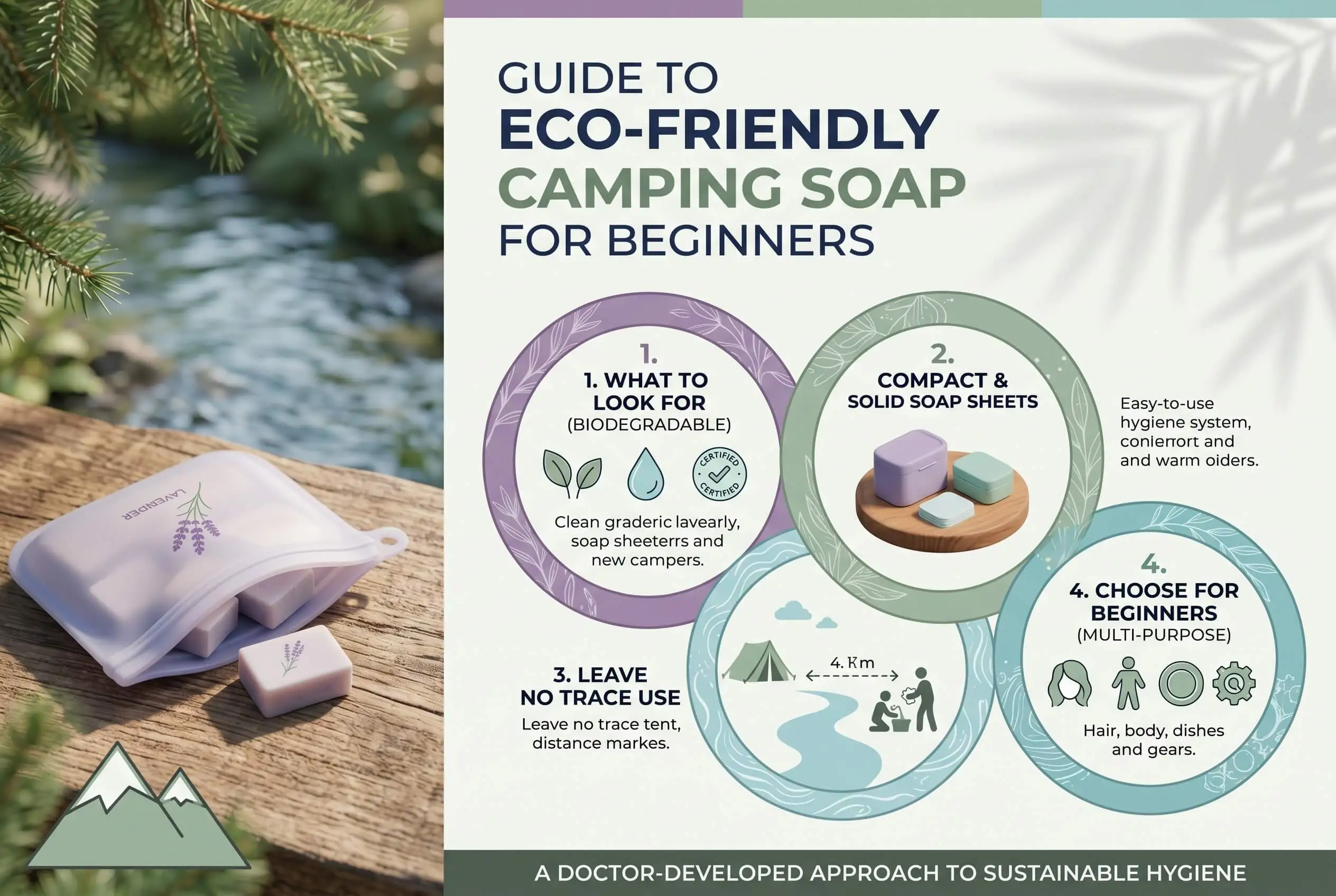
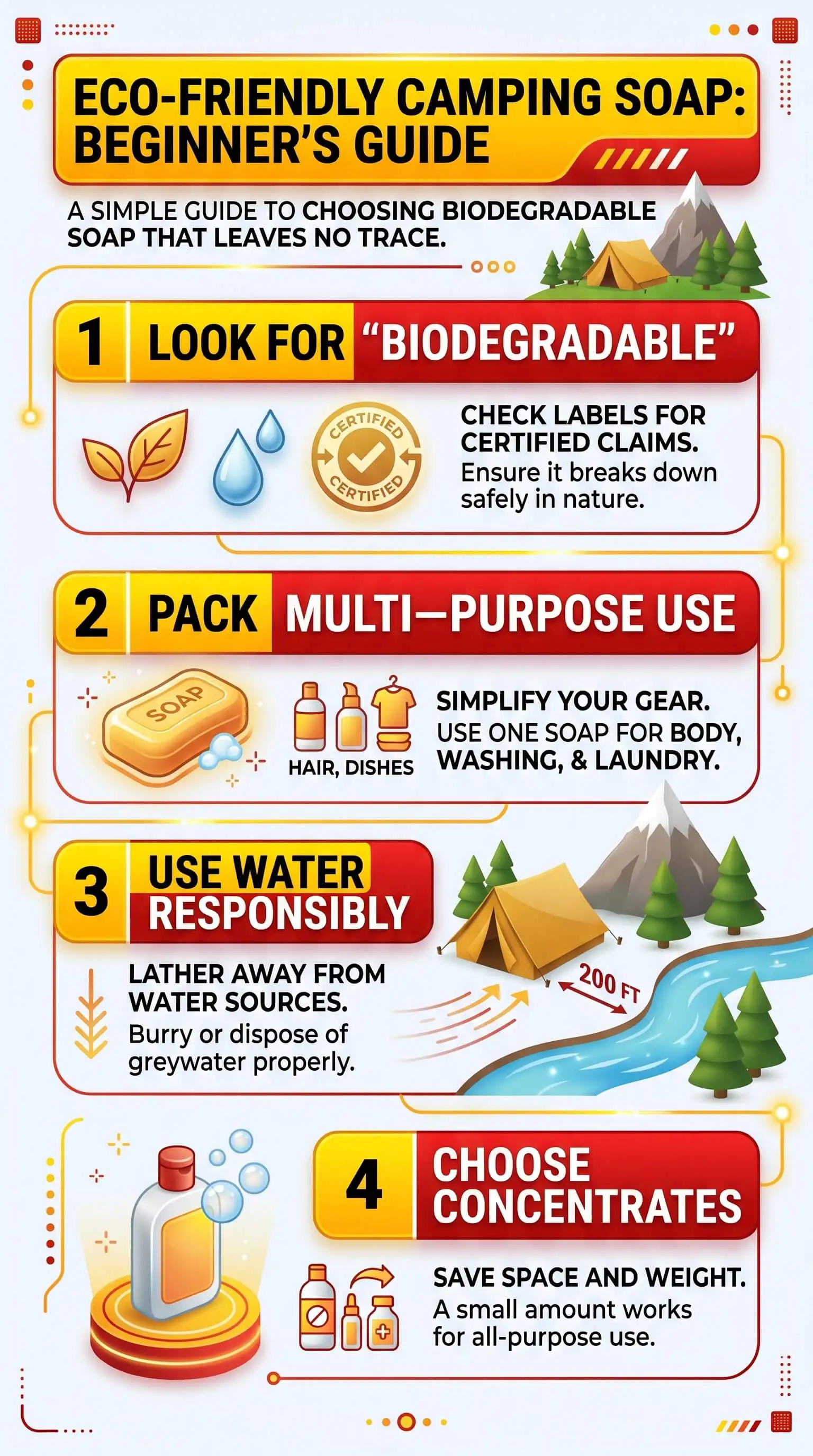
• Still requires correct use: at least 200 feet from any water source, used sparingly, and disposed of in a cathole six to eight inches deep.
• Unscented versions are preferred in bear country and near wildlife.
• Real biodegradability is verifiable through documentation, not through the word on the label alone.
Top Takeaways
• “Environmentally friendly” on a camp soap label means biodegradable in soil, not safe to rinse into water.
• Plant-based surfactants, phosphate-free, paraben-free, and low-to-no fragrance are the ingredient markers worth checking.
• Stay at least 200 feet from lakes, streams, and springs whenever soap touches skin, dishes, or clothing.
• Dispose of greywater in a cathole six to eight inches deep and cover it. Soil does the actual breakdown.
• Unscented is the right call in bear country and the safer default anywhere wildlife lives.
• Use concentrated soap in drops, not palmfuls. Most campers overuse by a wide margin.
What Makes a Soap Environmentally Friendly for Camping
Environmentally friendly camp soap is a soap built to break down cleanly in the soil after use, without leaving behind the synthetic residues that conventional soaps shed into waterways. The ingredient side is where the category earns the label. Look for plant-based surfactants instead of petroleum-derived ones, vegetable-based oils as the cleaning base, and an ingredient list that skips phosphates, parabens, sulfates, synthetic dyes, and synthetic fragrance. Any scent should come from essential oils at low concentrations, or be absent altogether.
A soap that passes those tests still is not automatically safe to rinse into a lake. Biodegradability happens in soil, where microbes do the work. Drop the same soap into moving water and it persists long enough to disrupt aquatic chemistry and harm fish and amphibians before it finally breaks apart. Ingredients are one part of the picture. Disposal is the rest, and it does more work than most campers give it credit for.
Why Conventional Soap Causes Problems Outdoors
Manufacturers design regular dish soap, shampoo, and body wash for drainpipes and treatment plants, not for open ground or wild water. Most contain synthetic surfactants derived from petroleum, phosphates that act as nutrient pollution once they reach a stream, synthetic fragrances that linger, and preservatives that aquatic species process poorly.
Nutrient loading is the quiet problem. A small amount of phosphate from soap in a creek feeds algae, algae blooms deplete oxygen, and fish suffocate in the dead zone that follows. Surfactants are the louder problem. They strip protective oils from fish gills and amphibian skin, which is how a small rinse can kill animals far bigger than the rinse itself.
The US Environmental Protection Agency flags personal care products as contaminants of emerging concern in surface waters, with measurable effects on aquatic organisms at very low concentrations. That is the reason “biodegradable” and “safe for a lake” are not the same claim.
How to Use Environmentally Friendly Soap for Camping Responsibly
The rule most campers get wrong is that biodegradable soap still needs soil to actually biodegrade, a principle that aligns with regenerative agriculture and healthy soil function. Used correctly, its impact is small. Used in a lake, the “biodegradable” label stops mattering.
1. Carry water to the wash site, not soap to the water. Fill a pot, a hydration bladder, or a collapsible bucket and step away from the bank before you open the bottle.
2. Stay at least 200 feet from any lake, stream, or spring. That is roughly 70 adult paces. Leave No Trace uses this distance as the working minimum.
3. Use a few drops, not a palmful. Most plant-based camp soaps are concentrated. Two or three drops handles a sinkful of dishes. A dime-sized squeeze handles a full handwash.
4. Strain food particles out of dishwater before you dispose of it. Pack the solids out in a sealed bag. Soapy water with food bits pulls in animals.
5. Dig a cathole six to eight inches deep, pour the greywater in, and cover it. Soil microbes finish the breakdown. Scatter-pouring is acceptable only on dry, durable surfaces at least 200 feet from water.
6. In bear country, pick unscented. Fragrance carries, and any fragrance in camp is a draw.
“From what I have tested on the trail, the single most common mistake I see is not the choice of product. It is the lake bath. People buy a plant-based camp soap, read “biodegradable” on the label, and assume that means a quick rinse in the water is fine. It is not, and the label does not say it is.”
7 Essential Resources
Bookmark these. Each one comes from a primary source worth checking directly.
7. Leave No Trace Center for Outdoor Ethics — The Skinny on Soap. Plain-language guidance from the organization that wrote the standard on outdoor soap use. Essential baseline reading.
8. Leave No Trace — The Seven Principles. The full ethical framework that camp soap disposal sits inside. Soap choices make more sense once the seven principles are familiar.
9. US EPA — Contaminants of Emerging Concern, including Pharmaceuticals and Personal Care Products. The federal science on how soap residues reach surface water and affect aquatic life.
10. US EPA — Safer Choice Criteria for Surfactants. The technical criteria a low-impact surfactant has to meet. Useful for checking what is actually in a bottle.
11. US EPA — Fact Sheet: Nonylphenols and Nonylphenol Ethoxylates. Names a class of surfactants worth avoiding in any soap, not only camp soap.
12. Federal Trade Commission — Green Guides. Federal guidance on what “biodegradable,” “natural,” and “eco-friendly” can legally mean on a label.
13. Backpacker Magazine — Your “Biodegradable” Soap Isn’t as Eco-Friendly as You Think. Field reporting that connects the label gap to real trail behavior.
3 Statistics
The scale of the audience whose soap choices reach open water is larger than the trailhead suggests.
14. More than 181.1 million Americans participated in outdoor recreation in 2024, which is nearly 60 percent of those aged six and older (Outdoor Industry Association, 2025 Outdoor Participation Trends Report). That is the audience whose soap choices reach real water.
15. Camping, hiking, and fishing each gained more than two million new participants in 2024 (Outdoor Industry Association, 2025 report). The category of people who might use soap near wild water is still growing quickly.
16. In one peer-reviewed environmental risk assessment, roughly 65 percent of the 26 personal care product compounds reviewed ranked as “highly toxic” or “harmful to aquatic organisms” (review published in PMC). The class of chemistry that sits inside most conventional soaps is the same class the study flagged.
Final Thoughts and Opinion
After years of testing camp soaps and watching people use them in the backcountry, my view has narrowed to one thing. The most environmentally friendly soap for camping is the one you use sparingly, dispose of in soil, and verify against a real biodegradability claim instead of a marketing word. Brand matters less than habit. A mediocre product used correctly beats a great product rinsed into a stream.
If you want a starting point, a plant-based camp soap formulated for backcountry use gives you a bottle that earns the label on both ingredients and performance. Whatever you pick, treat the 200-foot rule and the cathole as non-negotiable. Those two habits protect more water than any single product choice.
Frequently Asked Questions
Is biodegradable soap safe to use in a lake or stream?
No. Biodegradable soap still needs soil, microbes, and time to break down. In open water it behaves much like regular soap for long enough to harm aquatic life. Leave No Trace, the EPA, and every major camp soap manufacturer now state the 200-foot rule on their labels.
What is the best environmentally friendly soap for camping?
The best option is usually a concentrated, plant-based, fragrance-free soap with a short ingredient list and a biodegradability statement backed by documentation, not a slogan. Dr. Bronner’s Pure-Castile is a widely recognized choice. Specialty backcountry brands built for the same use case are worth looking at too.
How far should I wash from a water source when camping?
At least 200 feet, which is about 70 adult paces. The figure comes from Leave No Trace and is standard across US national parks and forest service land. The distance gives soil enough buffer to catch and break down the soapy water before it reaches the waterway.
Does Dr. Bronner’s count as eco-friendly camp soap?
Yes, in the category sense. Dr. Bronner’s Pure-Castile is plant-based, biodegradable, and widely field-tested by backpackers. The same disposal rules apply. The “18-in-1” label does not mean “safe in a lake.” Use it 200 feet from water and dispose of the greywater in a cathole.
Can I use the same soap for dishes, hands, and body on the trail?
Usually, yes. Most concentrated plant-based camp soaps are formulated for multi-use. That is part of what makes them practical on long trips. One small bottle replaces three or four specialty products. Check the label for any listed restriction, especially on sensitive skin or hair types.
What does “biodegradable” actually mean on a soap label?
In technical usage, biodegradable means the product breaks down into water, carbon dioxide, and biomass through microbial action, usually to a 90 percent threshold within six months, which mirrors how regenerative practices depend on active microbial life to restore and maintain healthy soil. In marketing usage, the term has no single legal definition in the US. The FTC Green Guides describe the standards that support or fail such a claim.
Call to Action
Your next trip is the best place to start. Pack a single concentrated bottle, measure in drops, wash 200 feet from water, and cathole the greywater. If you want a ready-made option built for this use, shop a verified eco-friendly camp soap and take it on your next overnight. Smaller footprint, same clean camp.